
Published on 15 September 2026
E-residents are forming companies faster than ever — what the 2026 numbers actually mean for founders
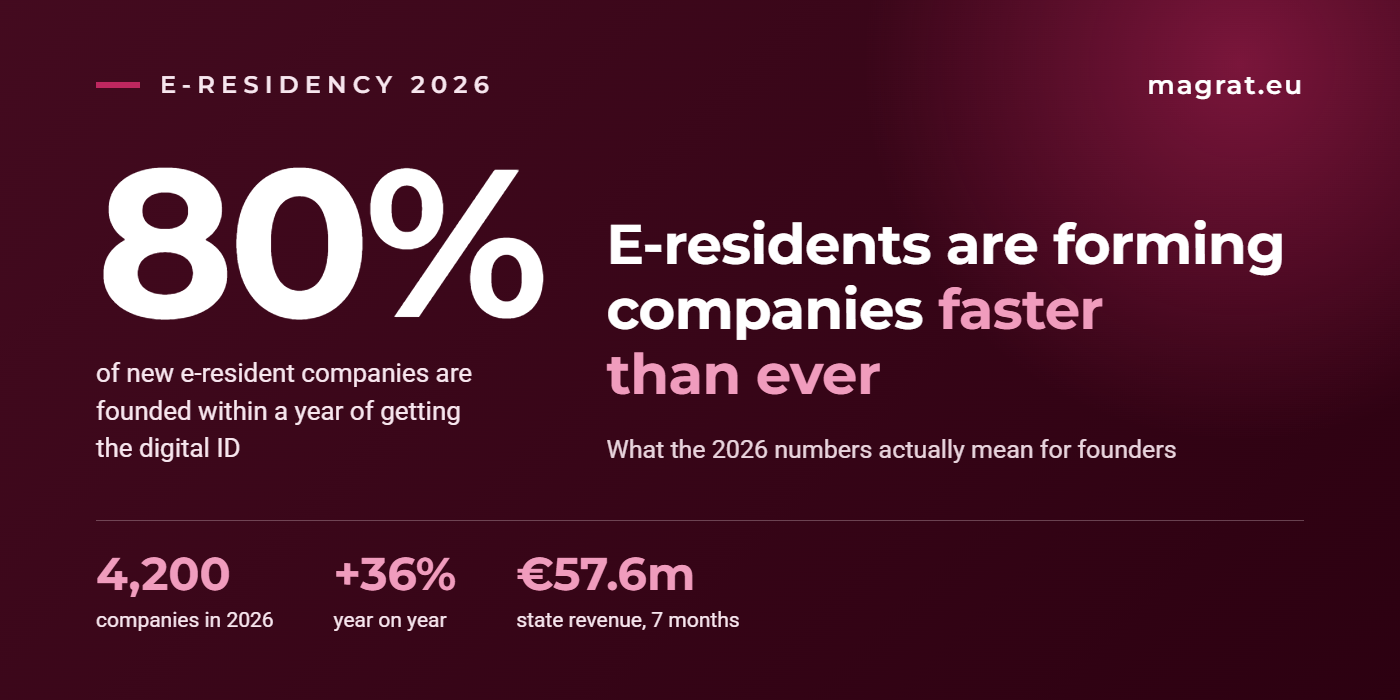
Estonia’s e-Residency programme — a state programme, run by the government’s Enterprise and Innovation Foundation under the Ministry of Economic Affairs — has published its 2026 figures, and one number stands out above the rest: 80% of all new e-resident companies are founded by people who received their digital ID in the same year or the year before. The gap between “I’m curious about Estonia” and “I have a registered company” is closing fast — and that changes how you should plan your own setup.
We were asked to comment on these numbers for the state programme’s own blog, so here is our reading of them from the inside — as the firm that handles the formation, the contact person service and the monthly accounting for several hundred of these companies.
The headline figures
From the e-Residency programme’s September 2026 update:
- over 4,200 companies founded by e-residents so far this year — around 600 per month;
- that is 36% more than the same period last year and 47% more than two years ago;
- 9,000 new e-residents since January, of whom a record 34% of the early-2026 joiners have already registered a business;
- €57.6 million in direct state revenue in the first seven months alone — €35.3m payroll taxes, €19.5m dividend income tax, €2.8m state fees;
- 144,000 e-residents from 187 countries and 44,000+ companies since the programme began; roughly one in five new Estonian companies each year now has an e-resident behind it.
Those are impressive totals. The operationally interesting part is the speed.
Why the 80% figure matters more than the totals
A few years ago, a large share of e-residents collected the card, looked around, and did nothing for eighteen months. Today the typical founder applies with a business already in mind: a client contract waiting to be signed, an EU invoicing entity needed by a specific date, a payment provider that requires an EU company. The digital ID is no longer the goal — it is a step in a plan that already has a deadline attached.
That has a practical consequence. If you compress formation into weeks rather than years, the decisions that used to be made slowly — share capital, VAT registration, contact person, who signs what, which country taxes the profit — all land at once, usually in the same month you are also trying to close your first deal. This is exactly where new founders lose time, and occasionally money.
NB! An Estonian company is fast to register and simple to run — but it is not a tax-free structure. Where your company is actually managed, where you are tax resident, and where your customers are will all affect your obligations. Get that mapped before registration, not after the first invoice.
What e-residents actually buy
A recent study found that e-residents purchased more than €18 million of business services through the official e-Residency Marketplace in 2025, with provider revenues up 17% year on year. Our own experience matches the programme’s description of demand: the first purchases are almost always company formation, the legally required contact person, and monthly accounting.
What changes later is the complexity. Once a company has employees in two countries, a holding above it, or revenue split between EU and non-EU customers, the questions stop being about bookkeeping and start being about cross-border tax and structure: permanent establishment risk, VAT treatment of digital services, dividend timing, transfer pricing on intra-group invoices. That second phase is where a good adviser is worth considerably more than the monthly fee.
Magrat in the programme’s own report
Magrat Baltic OÜ was the service provider the e-Residency programme asked to comment on the 2026 results — the programme is run by the Estonian state, and the report was published on its official blog alongside statements by the Minister of Economic Affairs and the programme’s director. As our founder Igor Raikhelgauz put it, e-Residency has given Estonian service firms the chance to build an international business from a local base — the Estonian market alone would not offer that room to grow. Over the last financial year our revenue grew by more than 60%, to €1.37 million, and the team expanded to 22 people.
We see the strongest growth among Ukrainian entrepreneurs, including the diaspora, while interest from Western Europe in the Estonian business environment remains consistently high.
The original article (in Estonian) is on the e-Residency blog: Värsked e-residendid jõuavad ettevõtte asutamiseni üha kiiremini.
Thinking about joining the 600 a month?
If you are somewhere between “I have the card” and “I have a company”, the useful next step is a short conversation about what you are actually building — the right structure, share capital and VAT decisions take twenty minutes to get right at the start and a great deal longer to fix afterwards. We handle formation, the contact person requirement, accounting and tax advisory in English, Estonian, Russian and Ukrainian: get in touch with us.